

























Can You Put Wallpaper In A Bathroom?
But wallpaper? Not so much. If you put wallpaper in bathrooms, you can expect peeling seams, bubbling surfaces, and damp creeping through patterns. Or so people will lead you to believe.
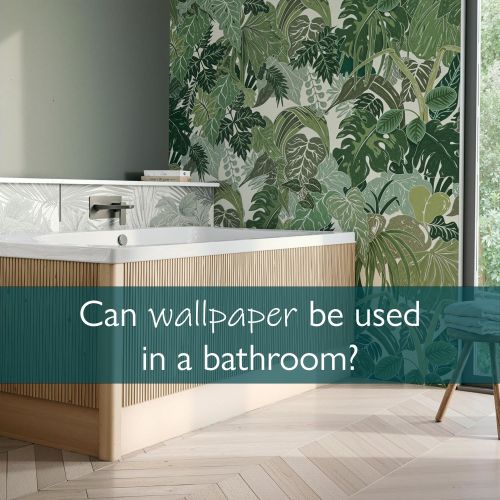
But that's not the case anymore. Wallpaper is holding its own as a finish for your bathroom walls, and many modern style guides often feature heavily wallpapered bathrooms.
So what's the truth? Can you put wallpaper in a bathroom? You absolutely can. Let's take a look.

Can you use wallpaper in a bathroom?
Yes, you can use wallpaper in bathrooms.
It does work, and it really works really well. That is, when people approach it correctly. There's a right way and a wrong way to implement wallpaper in the bathroom, and if you get it wrong, you'll notice almost immediately.
The main difference in wallpapering a bathroom is the wallpaper you use and the way you take on the task. Wallpapering a bathroom is not like wallpapering your bedroom or hallways.
Bathrooms generate persistent humidity, and your wallpaper needs to be able to cope with this, as well as temperature fluctuations and cycles of condensation as the bathroom gets used.
Every shower introduces steam into the air. Warm moisture rises, cools, then settles on walls, ceilings, and mirrors. And even bathrooms with good ventilation are exposed to repeated exposure to damp air.
In relation to bathrooms, however, you need to understand the distinction between airborne moisture and direct water contact.
Humidity alone does not destroy wallpaper. But prolonged saturation does. And when you see wallpaper fail in bathrooms, it will follow predictable patterns: seams lifting where moisture penetrates, adhesive softening under repeated steam exposure, or mould forming when dampness becomes trapped behind the paper.
And this is why older advice always steered clear of recommending wallpaper for bathrooms. Because traditional paper just didn't have any meaningful moisture resistance. Standard paper would just absorb the humidity, the adhesive would weaken, and your wallpaper would be ruined sooner rather than later.
But modern wallpaper can handle all of this. Bathroom wallpaper typically comes with protective coatings or vinyl layers designed specifically to tolerate moisture-heavy rooms.
And when you have a well-ventilated bathroom to disperse steam efficiently, you're reducing condensation build-up on the wall and limiting the amount that settles, meaning your wallpaper doesn't have the same level of moisture to contend with.
Because, for the most part, wallpaper issues aren't usually down to the paper itself, but rather symptoms of an environmental imbalance, i.e. your bathroom having poor ventilation.

What types of wallpaper work in bathrooms?
Not all wallpaper responds to moisture in the same way. Its combination of material composition and surface finish will directly influence durability in humid spaces.
Vinyl and moisture-resistant wallpapers
For the most part, vinyl wallpaper is often thought of as the most bathroom-friendly wallpaper. The vinyl surface acts as a barrier which prevents moisture from penetrating the decorative face.
This layer reduces absorption, improves dimensional stability, and allows for gentle cleaning, which, to be honest, is vital in a room where condensation is expected, and you're flushing toilets or brushing your teeth.
One of the main benefits of vinyl wallpaper and moisture-resistant wallpaper in bathrooms is that it can resist most bathroom issues.
They are less prone to bubbling because moisture can't easily migrate through the surface.
They tolerate humidity fluctuations better than untreated papers
They're able to be lightly washed or scrubbed, meaning you don't damage the colour or texture
When you compare this to untreated wallpaper, you can see the difference in suitability immediately, and it instantly removes many of the main concerns of putting wallpaper in bathrooms.
Peel-and-stick vs traditional wallpapers
You can use both normal wallpaper and peel-and-stick in the bathroom. But they both suit different conditions and expectations.
Peel-and-stick wallpaper is often chosen for convenience. You benefit from a cleaner installation, you can reposition it, and then remove it with no problem. Simple.
But the reasons they're often preferred in bathrooms are thanks to their flexible application and moisture resistance combination. That being said, adhesion to walls depends on surface preparation and environmental stability.
If the walls aren't prepared properly, you cannot expect the wallpaper to stick as expected. And if you hang peel-and-stick wallpaper on walls that are dusty, greasy, or uneven, humidity will weaken pressure-sensitive adhesives quickly.
Traditional wallpaper relies on paste or adhesive to form a stronger long-term bond, which peel-and-stick does not need. And when you install the wallpaper correctly with a humidity-resistant adhesive on correctly prepared walls, traditional wallpaper can offer superior seam stability.
Plus, you get a wider choice of colours, designs, and textures to choose from too.
But the trade-off for peel-and-stick vs traditional wallpaper is preparation precision. Wall condition, paste selection, and seam finishing are more critical in a bathroom.
For comparison, neither one is better than the other. Neither guarantees success nor failure. It's the combination of wallpaper materials, adhesive, wall preparation, and bathroom ventilation that determines performance here.
Where to put wallpaper in a bathroom
Now we know the answer to whether or not you can wallpaper bathrooms, the question remains: where do you put wallpaper in a bathroom exactly?
The walls you put wallpaper on will influence longevity, too. The reason is that bathrooms do not expose every wall to equal moisture levels.
Areas that are subjected to repeated direct water contact are automatically poor candidates to be wallpapered. This rules out shower enclosures, wet rooms, and heavy splash zones, i.e. around bath seals.
Even the most moisture-resistant wallpapers will struggle here, thanks to the constant penetration of water around seams or edges. You'll experience peeling, bubbling, and premature failure of the adhesive, and potentially the wallpaper itself, too.
On the flip side, more forgiving places to add wallpaper in bathrooms are feature walls away from direct spray, walls behind vanity units, areas behind toilets, and upper wall sections above tiling or panelling.
These surfaces experience humidity but limited saturation. Reduced moisture stress means improved longevity.
If you're thinking about visual impact from your wallpaper, the optimal position would be a feature wall, as they are less at risk of moisture damage and don't have the potential to overpower the bathroom as it might around mirrors or vanities.
But the best thing to know about what wall to put wallpaper on in the bathroom is that you need to consider your own bathroom and usage, and make your decision from there.

How to prepare your bathroom walls for wallpaper
It's a point that cannot be stressed enough, but preparation is one of the most decisive factors when it comes to wallpaper performance in any room, but especially for bathrooms. And many wallpaper “failures” actually stem from inadequate wall treatment prior to application.
Cleaning, priming and smoothing surfaces
All walls you are wallpapering should be cleaned thoroughly prior to application. Bathrooms will accumulate residue from soaps, aerosols, humidity film, and general airborne particles.
And these contaminants will interfere with adhesion and can cause premature seam lifting.
You also need to address any mould or mildew in the room. Treat it and make sure it's fully removed. If you wallpaper over existing mould, you'll just trap moisture, and it will grow beneath the surface. No one wants that.
Next up is surface condition. Cracks, dents, flaking paint, and uneven textures should all be repaired before you even consider adding wallpaper. Sand any rough areas, fill imperfections, and create a stable base so you can reduce stress on wallpaper seams.
Using mould-resistant adhesive and sealants
Standard adhesive isn't always enough for humid environments. Using bathroom-appropriate or mould-resistant paste offers improved durability under moisture exposure.
Choosing these adhesives means you can maintain seal integrity and resist degradation due to repeated humidity cycles.
Furthermore, edges and seams can be protected further by using a decorator’s varnish or suitable sealants. As moisture intrusion usually begins here rather than on wallpaper surfaces, this extra reinforcement in vulnerable areas supports wallpaper longevity by helping to prevent lifting and bubbling.
What are the pros and cons of bathroom wallpaper?
Wallpaper obviously incorporates clear aesthetic benefits for the bathroom. But it's not just a case of “I like it, it looks good, let's do it”.
The advantages are obvious. Wallpaper adds style, pattern, depth, and colour to any room, and it can really allow you to put your own stamp on the bathroom and deliver a room full of character and life. And it's also much easier and faster than retiling, not to mention more cost-effective.
However, the limitations are real, and there are some cons to adding wallpaper to a bathroom. Wallpaper, despite modern advances and coatings, still remains susceptible to moisture and poor ventilation.
Incorrect material selection or placement, or ineffective wall preparation, can lead to peeling, bubbling, and complete failure, not to mention the possibility of assisting mould growth.
But the truth is, despite the pros and cons of adding wallpaper to a bathroom, it's neither inherently fragile nor automatically problematic. The performance is solely dependent on the quality of the decisions behind it and the prep work.
So yes, you can add wallpaper to a bathroom, but you need to be informed, understand the reality of wallpapering a bathroom, and know how to prepare walls, choose the right paper, and where to hang it for the best results.