



















What is the average bath size, and how much water does it hold?

Understanding bath size and water use is important for a multitude of reasons. Design-wise, you need to know what size bath fits your space without looking too big or small. You also need to consider practicality; how big does a bath need to be for you to fit in it comfortably?
Picking the right bath size will ultimately determine how much water it can hold, which then brings in the idea of water usage. Choosing an unnecessarily large bath could mean you’re wasting water, which ramps up your bills every month.
With all of this in mind, let’s look at some of the burning questions on your mind - most notably, how long is a bathtub and how many litres does a bath hold?
What are the average bath dimensions in the UK?
When you buy a bath in the UK, you will normally see the sizes explained in millimetres, giving you a length x width for each product. Feel free to look at our bath product page to see a few examples of what this looks like. Now, let’s have a peek at the actual sizes available.Standard bath sizes
In the UK, the average size of a standard bath is 1700mm x 700mm. Most people don’t have any problems with this, though within this particular size range you may see the following:- Lengths ranging from 1500mm to 1800mm
- Widths ranging from 700mm to 800mm
- Depths ranging from 400mm to 450mm
Anything bigger or smaller than this will normally not fall under the “standard bath size” category.
Compact and larger variations
What is the average bath size for smaller or larger bath variations? A “compact” bath is usually anything that’s under 1500mm in length - we offer products that go down to around 1200mm for true space-saving benefits. On the other hand, a “large” bath will always be more than 1800mm long.Interestingly, the average width doesn’t change that much - unless you’re purchasing a special type of bath, like a corner tub. Across the board, it tends to stay at around 700mm or slightly under for compact baths, then maybe growing up to 900mm for large tubs.
With depth, smaller baths stay around the same, but you can get extra-deep large ones of up to 800mm.

How many litres does a bath hold?
Size matters because it determines how much water a bath holds, which will impact the amount of water usage you go through each time you run the taps for a relaxing soak. Here’s a breakdown of what the average bath can usually handle.Typical capacities for common bath types
An average-sized bath (1700mm x 700mm with between 400 to 450mm of depth), will hold up to 230 litres of water at full capacity. However, you can fill them with 120 to 150 litres for a comfortable soak.- Compact baths: Up to 180L maximum capacity, most people will use 90 to 120L
- Larger baths: 350+ litres maximum capacity, most people will use 170 to 220 litres
Factors that affect water volume
Apart from the length and width of your bath, the main things affecting water volume are:- Depth
- Bath shape
A deeper bath can hold more water than a shallower bath of the same length and width. Moreover, baths with sloped inner sides typically hold less water because the internal bath capacity is lower. If you want to maximise water volume, we recommend square baths with straight inner sides that don’t slope or curve inwards.
How long is a bathtub (what sizes mean in real life)?
You’ve seen the size of a bath, but that means nothing when you don’t have any perspective. You want to design a new bathroom or craft the perfect ensuite, so you have to see what these sizes mean in relation to real life.Converting sizes to space and comfort
Most adults in the UK can submerge in a 1700 x 700mm bath without much trouble. You can stretch out your legs and leave some of your upper body uncovered - or the taller folk can bend their legs slightly to cover their entire upper body.Larger baths (1800mm+) are usually big enough for the majority of people to stretch out and be completely submerged.
In terms of bathroom space, the average UK bathroom sits at around 2300 x 2700mm in size. Placing a standard 1700 x 700mm bath here means you’ve got an additional 5.02 square metres of floorspace to play with. For context, that’s about 80% of the bathroom's total floor space.
Choosing the right size for your bathroom layout
Ultimately, you should measure your bathroom’s floor space, and this will determine how big your bath can be. It’s also worth considering where you’ll place the bath - up against the wall or in a corner will always be more space-conservative.Our pro tip is to start with the other bathroom essentials - your toilet, sink, storage, possibly a shower etc. Then, this leaves space for a bath, and you should be able to figure out what size fills the empty space the most.

Bath vs shower: Water use comparison
What uses more water, a bath or a shower? It’s one of those questions where you assume the answer is obvious, but it’s a bit more complicated than you think.How many litres a bath uses vs showers
According to one of the UK’s leading water providers, the average 5-minute shower uses 75 litres of water. So, if you’re in there for 10 minutes, you’re using 150 litres. The same research found that the average person only fills their bath with 80 litres of water.It depends on how big your bath is - and how much you fill it - but you can manage things to ensure that you use less water than a 10-minute shower. Better still, you get to stay in the bath for longer without using more water.
Break-even shower length and flow rate
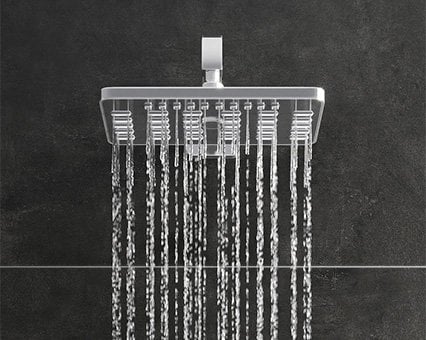
However, if you reduce your showers to just 5 minutes, you’ll almost always use less water. It also depends on the shower head’s flow rate, which controls how much water is pushed through - and this is measured in litres per minute (LPM).For example, you could run a shower using a 12 LPM flow rate, or you can find a more economical shower head offering 6 LPM. In this comparison, you can cut your water usage in half, provided you’re in the shower for the same length of time.
All in all, when it comes to water usage, it’s up to you to decide what is best. Most people will have a shower and a bath - the shower is for everyday use to wash quickly, while the bath offers a more relaxing soak at the end of the week.
Tips for saving water with your bath and shower
If you want to save water when using your shower or taking a bath, these tips will help:- Reduce your showers to 5 minutes or less
- Switch to a lower LPM flow rate shower head
- Don’t fill your bath up too much - halfway is usually more than fine
- Opt for a slightly deeper bath size - this helps with water displacement, so less water can feel like a lot more
Overall, this guide should explain everything you need to know about bath sizes, how much water a bathtub can hold and water consumption. If you’ve got any additional questions or want advice on buying the right bathroom for your home, feel free to get in touch.
Read more from us
May 21st 2015 | 4 min read | By Owen